
28 September, 2026
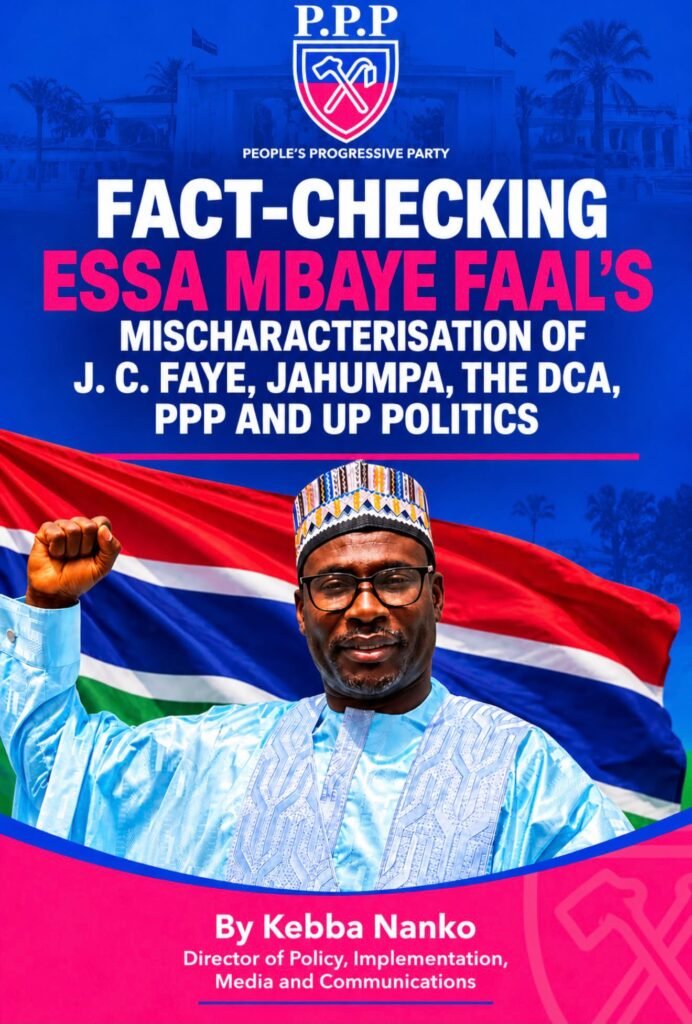
FACT-CHECKING ESSA MBAYE FAAL’S MISCHARACTERISATION OF J. C. FAYE, I.M GARBA JAHUMPA, THE DCA, PPP AND UP POLITICS
By Kebba Nanko
Director of Policy, Implementation, Media and Communications
During his interview with Coffee Times with Peter Gomez, Essa Mbaye Faal referred to two historical situations in an effort to justify his alliance with the NPP. However, the way he presented these events does not accurately reflect the political circumstances of the time, which need clarification for young people.
The first historical example was the relationship between J. C. Faye, I. M. Garba-Jahumpa and Sir Dawda Jawara, particularly the formation of the Democratic Congress Alliance (DCA) and its subsequent understanding with the PPP.
J. C. Faye and Jahumpa took a decisive and politically risky step by forming an alliance with the PPP. At the time, the PPP was still a young party and had already been subjected to tribal characterisation, including being labelled as a Mandinka-oriented party. For prominent Banjulian politicians such as J. C. Faye and Jahumpa to work with the PPP therefore carried significant political risks. Indeed, both ultimately lost their seats in that election.
The United Party, led by P. S. Njie, was one of the strongest and most established political forces in The Gambia. J. C. Faye and Garba-Jahumpa were therefore not opposition politicians abandoning the opposition to join an established PPP government. They were political actors operating within an opposition environment and seeking to challenge the dominance of the UP.
The DCA and PPP also had different areas of political strength. J. C. Faye and Garba-Jahumpa concentrated their efforts in the Colony, while the PPP had significant support in the Protectorate. Their understanding was therefore a tactical electoral arrangement intended to strengthen the political forces challenging the dominant UP.
The election itself did not produce a straightforward outcome. J. C. Faye and Garba-Jahumpa lost their individual seats, although A. B. Njie, a DCA candidate, was able to win his contest.
The constitutional arrangements at the time created a complicated political situation. Although the PPP argued that it had secured the popular support necessary for Sir Dawda Jawara to become Chief Minister, the parliamentary numbers did not provide the PPP with an outright majority. The Governor ultimately appointed P. S. Njie as Chief Minister.
That decision led to an important political development. Sir Dawda Jawara and Sheriff Ceesay of the PPP, together with A. B. Njie of the DCA, resigned from government in protest against the appointment of P. S. Njie.
This historical record shows that the DCA-PPP understanding arose from the political circumstances surrounding self-government and independence, rather than from an established PPP government recruiting opposition politicians into government.
These politicians were prepared to sacrifice government positions rather than compromise the political objectives for which they had entered the alliance. This is fundamentally different from the way Essa Faal appears to portray the relationship.
THE E. D. NJIE EXAMPLE
The second example Essa Faal referred to was P. S. Njie’s younger brother, E. D. Njie, and his appointment to government.
After Sir Dawda Jawara eventually defeated P. S. Njie and the UP and became head of government, he sought to reduce political divisions and promote national cooperation. He reached out to former political opponents and was prepared to offer them an opportunity to participate in government.
“And the PPP took the lead. We made it clear that we were open to cooperation, even to the extent of being partners in a Government of national unity. To prove our good faith, E. D. Njie, the UP’s deputy leader, was invited on the occasion of the very first cabinet reshuffle after independence to join the Government as Minister of Health. Njie took up the offer and remained in Government for months.” The Voice of the People: The Story of the PPP, 1959–1989, page 113 (new version).
That appointment did not sit well with P. S. Njie, and E. D. Njie later resigned. This was therefore not a PPP-UP electoral alliance. It was an attempt by a victorious political leader to reach across the political divide and promote national cooperation after an election.
The two historical examples therefore occurred in very different political circumstances. The DCA-PPP understanding was part of the political struggle surrounding self-government and independence, while E. D. Njie’s appointment took place after independence as part of an effort to promote national cooperation.
Essa Faal has every right to make and defend his own political decision. However, he should not selectively interpret the history of our independence struggle to make today’s political choices appear historically identical to those made by P. S. Njie, J. C. Faye, I.M Garba-Jahumpa, AB Njie and Sir Dawda Jawara.
Therefore, Essa Faal’s account of history was misleading and historically inaccurate.
Note of Reference: The title of the PPP book is The Voice of the People: The Story of the PPP, 1959–1989 (New Version). Available at Timbuktu.