
Date: August 19, 2026
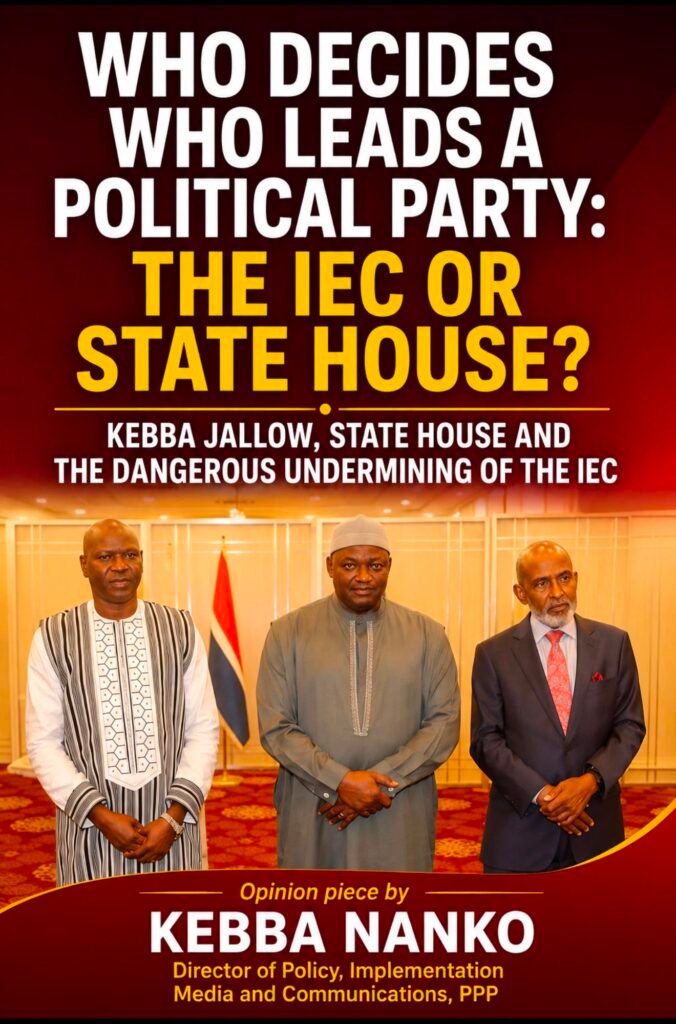
Who Decides Who Leads a Political Party: The IEC or State House? Kebba Jallow, State House and the Dangerous Undermining of the IEC
By Kebba Nanko
I write to further add my personal opinion to the statement made by Dr. Lamin Manneh of UDP.
In my view, what has happened regarding Kebba Jallow goes beyond hypocrisy. It raises a serious question about the authority, independence, and credibility of the Independent Electoral Commission (IEC), particularly as The Gambia approaches the December 5, 2026 presidential election.
Kebba Jallow, who has been expelled from the People’s Progressive Party (PPP), contested the PPP Congress election, lost, and refused to accept the outcome. He is not recognized by the IEC as the leader of the PPP. Yet he was received at State House and referred to as the PPP leader.
When the PPP publicly rejected that representation and clarified that Kebba Jallow was not its recognized leader, one would have expected State House to correct the record. Instead, President Adama Barrow, through his official Facebook page, further reinforced the same characterization. Neither State House nor the NPP has subsequently issued a clarification explaining or correcting the representation.
That silence is deeply troubling.
President Barrow’s own mandate rests on the authority of the IEC. The Commission administered the elections, declared the results, and recognized him as President. If the IEC is legitimate enough to establish the President’s mandate, why should its recognition of the legitimate leadership of another registered political party be disregarded when it becomes politically inconvenient?
This is not about whether President Barrow agrees with the PPP. It is about whether the same democratic standards apply to everyone.
Kebba Jallow has every right to challenge decisions through lawful means. But losing a democratic contest and refusing to accept the result cannot become a basis for another political party or the Presidency to recognize him over the leadership chosen by the party’s members and recognized by the IEC.
If this principle is allowed to stand, it creates a dangerous precedent. What happens tomorrow if someone loses an NPP leadership contest and refuses to accept the result? Would President Barrow and the NPP accept another government or political party recognizing that defeated candidate as the leader of the NPP?
If the answer is no, then the same standard must apply to the PPP.
There is an even more serious concern if, as Kebba Jallow has stated, his actions are intended to prevent the PPP from entering into an alliance with the United Democratic Party (UDP). A registered political party has the right to determine its leadership, political direction, and alliances through its lawful structures. An individual who has lost a party election should not be able to use political recognition or external support to frustrate those decisions.
That would not merely be an internal party dispute. It would raise legitimate concerns about interference in the political and electoral process.
This is why civil society must speak.
If we genuinely regard political parties as governments-in-waiting, then the democratic rights of their members must be protected. The right of PPP members to choose their leadership and determine the political direction of their party cannot be undermined simply because others disagree with the outcome.
Civil society should defend democratic institutions consistently, regardless of which political party benefits or loses.
There is also a painful irony in the present situation. Kebba Jallow’s refusal to accept defeat reminds me of the events surrounding former President Yahya Jammeh in 2016, when he initially accepted the election result before later reversing his position. Gambians and the international community, with President Barrow among those who stood for the principle at the time, insisted that the people’s decision must be respected.
Today, it is difficult not to see the contradiction if the same President who once stood for respect for the people’s voice is now perceived to be supporting a person who lost a democratic party contest and refused to accept the outcome.
The principle should never change depending on who benefits.
The PPP respects all democratic institutions and the rule of law. We respect the IEC and its mandate. Our position is not about weakening the Commission; it is about ensuring that its authority is respected by everyone, including the government and the governing party.
This is why President Barrow and the NPP must clarify their position.
If they respect the IEC’s recognition of the PPP leadership, they should say so clearly.
If they believe Kebba Jallow is the legitimate leader of the PPP despite the IEC’s position, they should explain the legal and institutional basis for that claim.
They owe that explanation to the PPP, to the IEC, and to the Gambian people.
As we approach December 5, 2026, this matters enormously. The legitimacy of an election depends not only on how votes are counted but also on whether citizens believe the institutions responsible for administering elections are independent and respected.
If the authority of the IEC can be disregarded in a political-party leadership matter, Gambians are entitled to ask whether its authority will also be respected when the outcome of a presidential election is politically inconvenient.
Will President Barrow accept the IEC’s result if he loses?
Will the NPP accept it?
I am not alleging that they will reject an election result. I am asking whether the conduct we are witnessing today gives Gambians sufficient confidence that the IEC’s authority will be respected tomorrow, regardless of the outcome.
President Barrow cannot reasonably expect Gambians to accept the IEC’s declaration on December 5 if his government and governing party are perceived to disregard the Commission when its decisions are inconvenient.
The President has an opportunity to remove this doubt.
He should affirm the authority and independence of the IEC, respect the legitimate leadership of registered political parties, and ensure that State House does not become a place where political legitimacy is conferred in contradiction of the country’s electoral institutions.
The NPP should do the same.
Because this is no longer simply about Kebba Jallow.
It is about whether the IEC will remain an institution whose authority is respected by all—or one whose decisions can be selectively ignored when they become politically inconvenient.
As we approach December 5, 2026, the choice should be clear: respect the institutions, respect democratic outcomes, and respect the voice of the people.